Curve Ensemble Gradient Descent
Reconstructing dynamics from few measurements is a crucial task in all fields where time evolution plays a role. In this project, we aim to reconstruct the global motion of regularized time-dependent systems by looking only at a finite number of particle trajectories. To accomplish this, we develop the Curve Ensemble Gradient Descent (CEDG) algorithm , which we utilize to investigate real-world time-dependent systems. Since the CEDG algorithm optimizes only on ensemble of trajectories, its convergence guarantees to the global dynamics will provide an answer to the question: how many trajectories do we need to describe a dynamics ?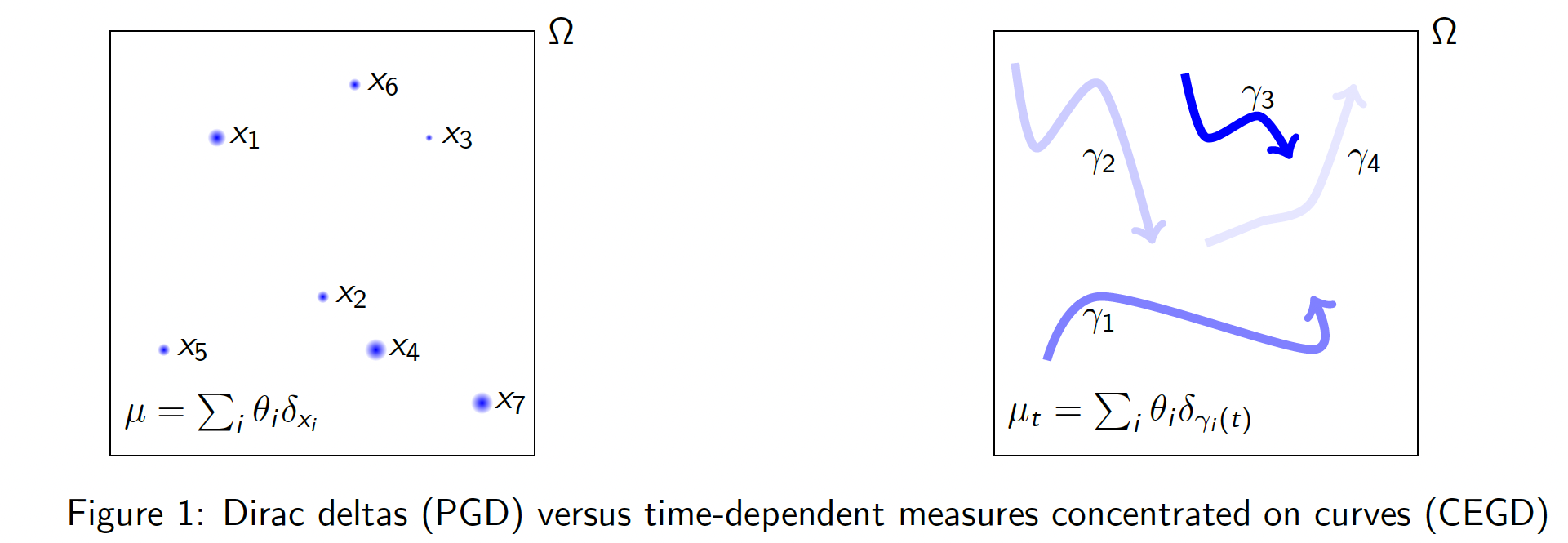
We aim to apply the CEGD algorithm to both synthetic and real-world biological data for solving Single Particle Tracking (SPT) tasks. SPT is a powerful tool for studying the dynamics and interactions of individual molecules in living cells (See figure below, taken from http://celltrackingchallenge.net/). By tagging molecules of interest with fluorescent probes and tracking their movements over time, SPT can reveal key insights into cellular processes. Crucially, we will not fix an underlying grid in space, enabling a super-resolved reconstruction of the trajectories.

Bibliography:
• Kristian Bredies, Marcello Carioni. Sparsity of solutions for variational inverse problems with finite-dimensional data. Calculus of Variations and Partial Differential Equations (2020)
• Kristian Bredies, Marcello Carioni, Silvio Fanzon, Francisco Romero. A generalized conditional gradient method for dynamic inverse problems with optimal transport regularization. Foundations of Computational Mathematics (2024)
• Marcello Carioni, Julius Lohmann. Sparsity for dynamic inverse problems on Wasserstein curves with bounded variation. Inverse Problems (2025)
• Christian Amend, Marcello Carioni, Kostantinos Zemas. Atomic Gradient Flows: Gradient flows on sparse representations . (2026)